By Ritik Kumar
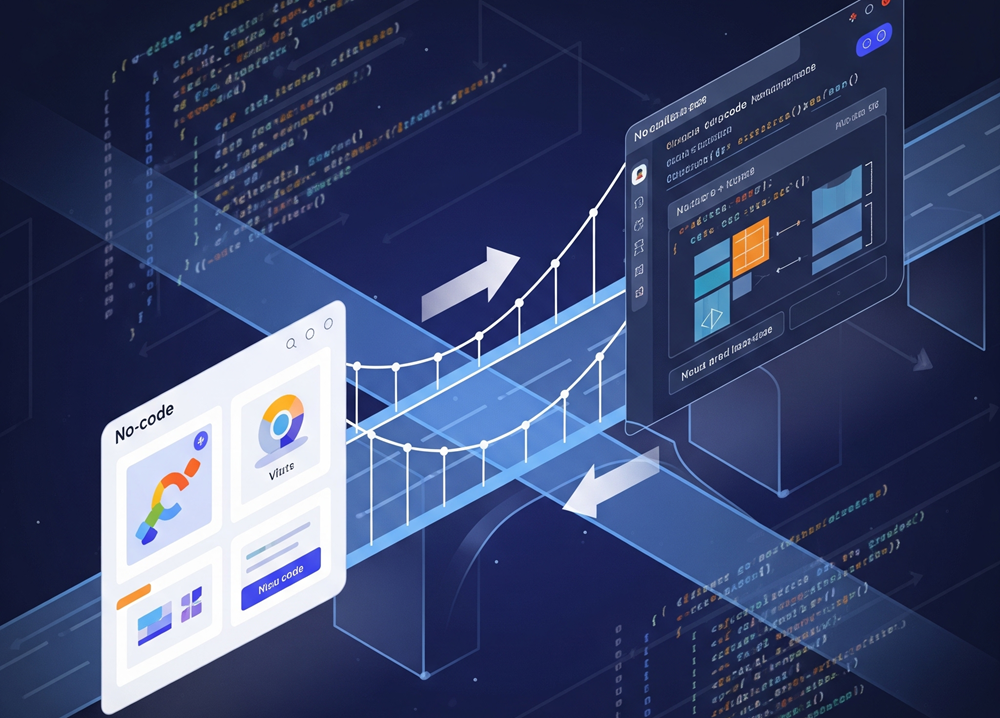
The rise of no-code development platforms has sparked a lively debate in the tech world: are we witnessing the twilight of traditional programming, or is this just another evolution? With tools promising to let anyone build sophisticated applications without writing a single line of code, it's natural to wonder about the future of the programmer.
Let's dive into the fascinating interplay between no-code and the enduring need for skilled programmers.
The No-Code Revolution: Empowerment and Acceleration
No-code development is, simply put, a visual approach to building software. Instead of writing code, users drag and drop pre-built components, configure workflows, and connect data sources through intuitive graphical interfaces. This paradigm shift offers several compelling advantages:
-
Democratization of Development
No-code empowers "citizen developers" – business users with deep domain knowledge but no coding skills – to create solutions tailored to their specific needs. This significantly broadens the pool of people who can contribute to software creation. -
Rapid Prototyping and Deployment
The speed at which applications can be built and launched with no-code tools is astonishing. This agility allows businesses to quickly test ideas, iterate on products, and respond to market demands far more rapidly than with traditional development cycles. -
Cost Efficiency
By reducing the reliance on highly specialized and often expensive coding talent, no-code can significantly lower development costs, making digital transformation more accessible for small and medium-sized businesses. -
Focus on Business Logic
With the underlying code abstracted away, users can concentrate purely on the business logic, user experience, and the problem they are trying to solve, rather than getting bogged down in syntax and debugging.

The Enduring Value of the Programmer: Beyond the Drag-and-Drop
Despite the impressive capabilities of no-code, the notion that it will render programmers obsolete is a misconception. Instead, it's transforming their role, making it more strategic and impactful. Here's why programmers will remain indispensable:
-
Complex Customization and Unique Logic
No-code platforms operate within a predefined set of functionalities and templates. When a business requires highly specialized, bespoke features, unique algorithms, or integrations with legacy systems that aren't natively supported, traditional coding is the only way to achieve it. Programmers are essential for pushing these boundaries. -
Scalability and Performance Optimization
For large-scale enterprise applications handling massive data volumes or high user traffic, performance and scalability are paramount. Optimizing these aspects often requires deep knowledge of system architecture, database design, and low-level code tuning – areas where no-code platforms often fall short. -
Security and Governance
Building truly secure and compliant applications, especially in regulated industries, demands meticulous attention to detail at the code level. Programmers are crucial for implementing advanced security protocols, conducting thorough vulnerability assessments, and ensuring adherence to complex regulatory frameworks. -
Integration with Advanced Technologies
While no-code tools are increasingly integrating with AI and other emerging technologies, the development of these core AI models, complex machine learning algorithms, or bespoke blockchain solutions still requires expert programming knowledge. Programmers build the "engines" that no-code platforms later leverage. -
Debugging and Problem Solving
When things go wrong in a complex system, identifying and fixing root causes often requires an understanding of the underlying code and infrastructure. Programmers are the diagnosticians and problem-solvers for the intricate digital machinery. -
Building the No-Code Platforms Themselves
Ironically, no-code platforms are built by programmers. The visual interfaces, drag-and-drop functionalities, and pre-built components that empower citizen developers are all meticulously coded by skilled software engineers.
The Future: A Hybrid Landscape
The most probable future is not one of replacement, but of coexistence and collaboration. We are moving towards a hybrid development landscape where:
- Citizen Developers will rapidly build internal tools, automate workflows, and create basic applications, freeing up IT departments.
- Traditional Programmers will focus on complex core systems, developing custom functionalities, building robust APIs for no-code integration, ensuring scalability and security, and creating the next generation of no-code platforms themselves.
- Low-Code Platforms (which allow some coding alongside visual development) will bridge the gap, enabling professional developers to accelerate their work while maintaining flexibility for customization.
Programmers will evolve from being solely code-writers to becoming architects, system integrators, performance optimizers, security specialists, and mentors for citizen developers. Their skills in logic, problem-solving, and understanding complex systems will remain invaluable, even if the tools they use, or the way they interact with them, continues to change.
Conclusion
No-code development is a powerful force democratizing software creation and accelerating innovation. However, it's a complementary tool, not a replacement for the deep expertise of professional programmers.
The future of software development is not a zero-sum game, but rather a more inclusive and efficient ecosystem where both no-code advocates and seasoned programmers play crucial, distinct, and highly valuable roles.